
What is it?
Artist
Franklin Boggs (Warsaw, Indiana 1914 – 2009 Beloit)
Title
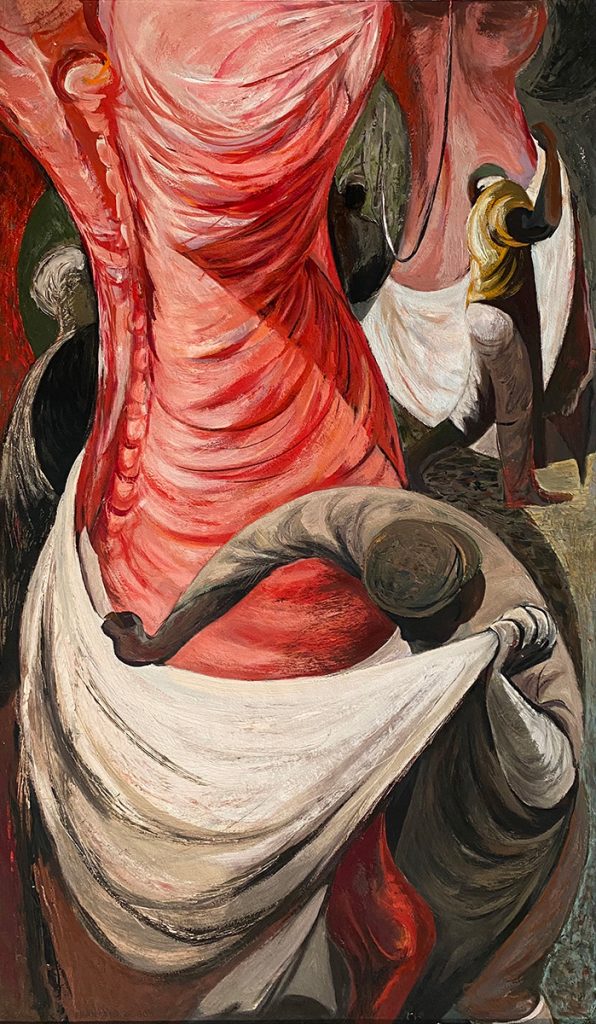
Stripping Hides at the Packing House (from Art in Tanning series)
Year
1958
Medium
Oil on Masonite
Dimensions
40 x 24 in.
Credit line
Gifted 2020, Katherine and Thomas Hauske, Jr. Family
About the Work
About
A remarkable blend of realism and abstraction, Stripping Hides at the Packing House is the first of nine artworks in the series Art in Tanning by Franklin Boggs from 1958. Anonymous workers muscle white hides from suspended red carcasses in a composition that reinforces the brute physicality of the subject. Sweeping curvilinear gestures turn a laborious and bloody process into a powerful and rhythmic orchestration of industrial activity that epitomized the postwar era.
Commissioned by Albert Trostel & Sons in Milwaukee, one of the world’s largest tanneries in the mid-twentieth century, Boggs commemorated the centennial celebration of the company’s tanning process—from the packing plant to shoe fabrication. Documenting not only the backbreaking labor of workers but the early adoption of industrial machinery, Boggs’s paintings poignantly capture the mid-century optimism that accompanied the American transition from skilled craft to industrial production. By 1958, Trostel & Sons produced 60 million square feet of leather a year, enough for 30 million pairs of shoes, establishing the company as a frontrunner of the leather industry.
Boggs garnered significant national attention during his career. In 1948, Life magazine named him one of the best young American painters and over the following two decades he won coveted commissions from national corporations and nonprofit entities such as Abbott Laboratories, Hiram Walker & Sons (Imperial Whiskey), Mayo Clinic, National City Bank, Standard Oil. His paintings can be found in the collections of the Art Institute of Chicago, the Corcoran in Washington, DC, New York’s Metropolitan Museum of Art, and the U.S. Army Center for Military History in Washington, DC.