
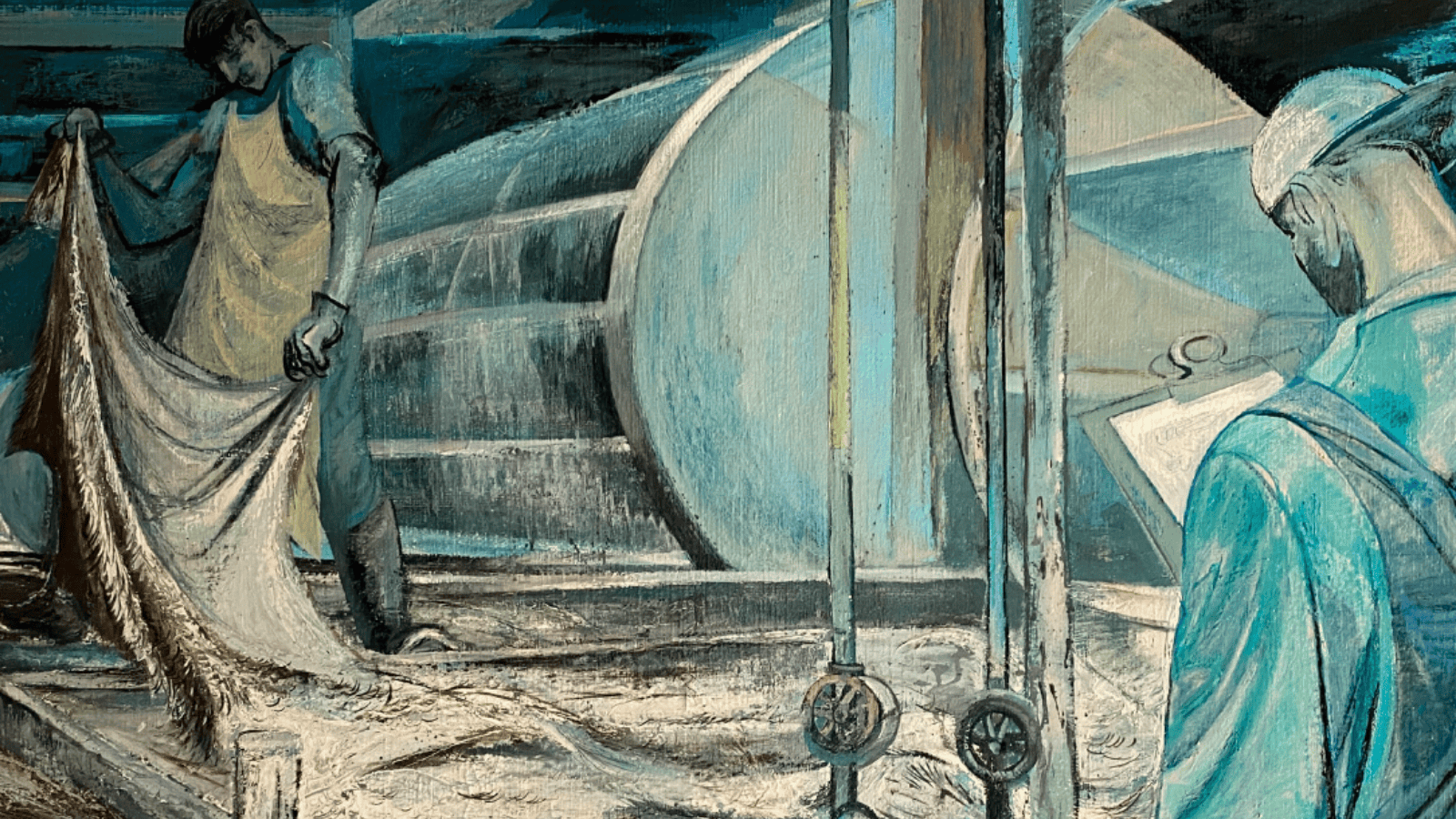
(WEST BEND, WISCONSIN) – Museum of Wisconsin Art is delighted to present Franklin Boggs: The Art of Tanning, a collection of nine paintings by Franklin Boggs (1914–2009), a Regionalist painter whose style has strong affinities with John Steuart Curry, Grant Wood, and Thomas Hart Benton. Commissioned by the Albert Trostel & Sons tannery, Boggs depicts the complete tanning process—from packing plant to shoe store—highlighting the industrial labor of postwar-era business boom. A gift to MOWA from the Katherine and Thomas Hauske Jr. Family, this is the first time in more than sixty years these paintings will be on public view. Franklin Boggs: The Art of Tanning is open March 8 through June 8.
As part of Albert Trostel & Sons’ centennial celebrations in 1958, Boggs was asked to “portray and interpret the strength and character of leather tanning.” His work commemorates the backbreaking labor and increasing use of industrial machinery that helped propel the company to the forefront of the leather industry. “These stunning nine canvases by Franklin Boggs detail in vivid color the craft of tanning, serving as a testament to hard work and time-honored industrial practices,” said Graeme Reid, Senior Curator at MOWA.
Trained as a scene painter of rural life and farm labor, Boggs gradually shifted his focus to heroicized depictions of industrial work. Between 1945 and 1960, he won coveted commissions from national corporations and nonprofit entities such as Abbott Laboratories, Hiram Walker & Sons (Imperial Whiskey), Mayo Clinic, National City Bank, Standard Oil, and, in Milwaukee, Albert Trostel & Sons. “Like other Regionalist artists, much of Boggs’s works focuses on the Midwestern working class,” said Dr. Jane Aspinwall, MOWA’s Deputy Director. “The paintings included in this exceptional gift capture the transition from labor-intensive work to industrial production, a pivotal moment in Wisconsin (and American) history.”
Join MOWA for Franklin Boggs: The Art of Tanning, an exhibition that celebrates the grit and innovation of Wisconsin’s industrial past.
###